18 Oct 2026
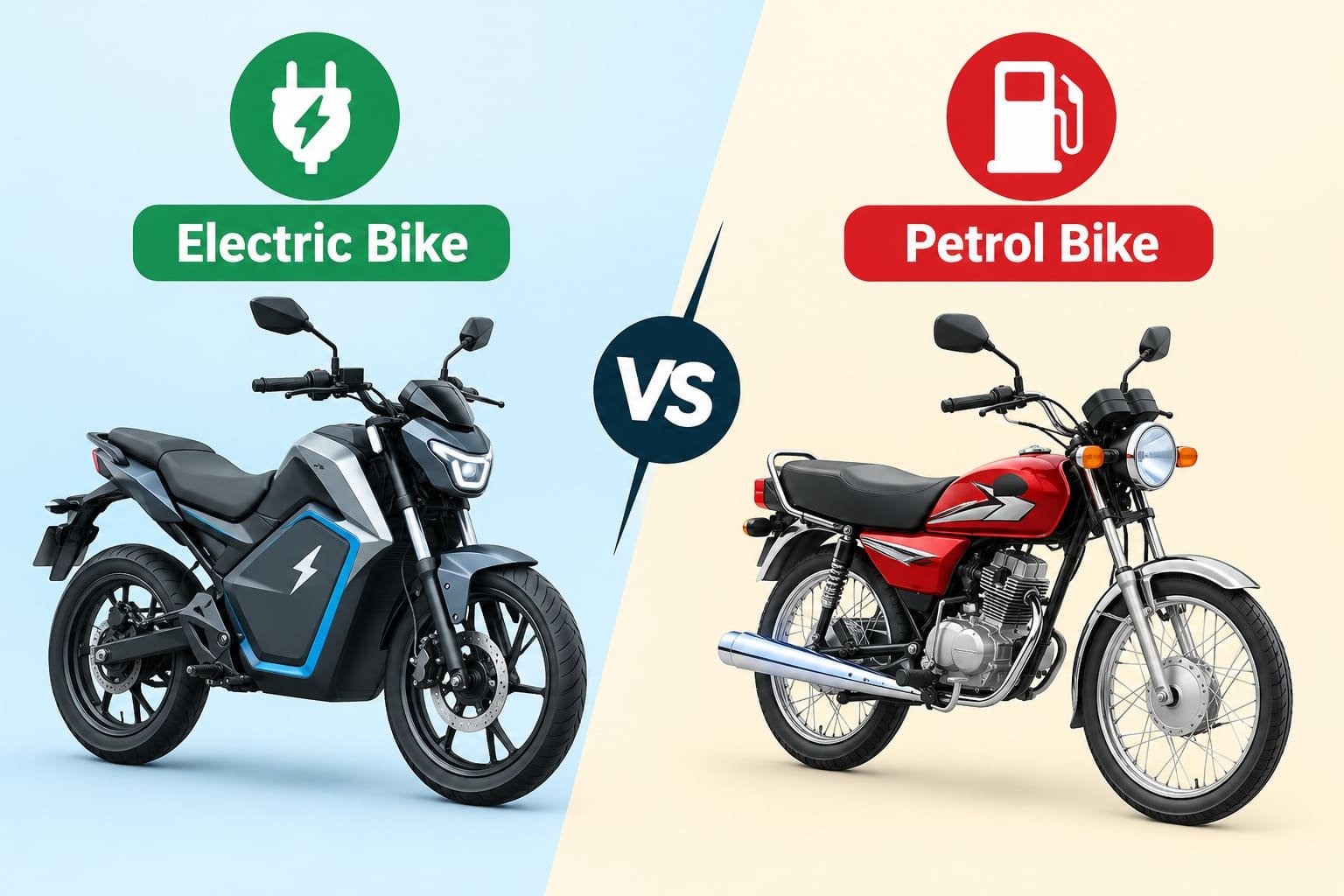
Electric vs Petrol Motorcycle: A Fair Way to Compare Running Costs
As fuel prices rise, many riders wonder whether an electric motorcycle would save them money. The answer depends on how far you ride, what electricity costs where you live, how long the battery lasts and what the bike costs to buy. This article gives you a method to work it out with your own numbers instead of relying on a sales pitch.
Start with the running cost per kilometre
For a petrol motorcycle, divide the price per litre by the kilometres you get from a litre. At an illustrative Rs 400 per litre and 40 km per litre, the bike costs Rs 10 per kilometre.
For an electric motorcycle, find how many units (kilowatt-hours, or kWh) of electricity it needs per kilometre. Suppose the bike uses about 0.04 kWh per kilometre, which is 40 watt-hours. If your electricity costs Rs 50 per unit, the cost is 0.04 x 50 = Rs 2 per kilometre. Both figures are only examples. The electricity price in your household bill depends on your tariff and the slab you fall in, and the bike's real consumption is in its specifications and in your own measurement.
Check the charging losses
Not all electricity drawn from the wall reaches the battery. Chargers waste some, so assume that you pay for perhaps 10 to 15 per cent more energy than the bike's rated use. Taking the example above, that raises the cost from Rs 2 to about Rs 2.30 per kilometre. The gap with petrol is still large.
Now count the purchase price
Electric motorcycles often cost more to buy than petrol ones of similar performance, and the battery is the main reason. Suppose an electric bike costs Rs 150,000 more than a comparable petrol bike. A rider covering 1,000 km a month saves about Rs 7,700 a month in running costs in our example (Rs 10 minus Rs 2.30 per km, times 1,000). It would take around 19 months to recover the extra price. A rider covering 400 km a month saves about Rs 3,080, and recovery takes about 49 months, which is over four years. Distance is the deciding factor.
The battery is the big unknown
Batteries wear out. Ask the seller for the type of battery, the warranty in years and in charge cycles, and the cost of a replacement. A bike that needs a Rs 100,000 battery after three years may lose much of its savings. Ask also what happens to range as the battery ages, because a bike advertised at 80 km a charge may deliver much less after a few years or in hot weather or with a passenger.
Other costs and savings
- Maintenance. Electric motorcycles have fewer moving parts and no engine oil, spark plugs or air filter, so routine servicing is usually cheaper. Tyres, brakes, suspension and the chain still need attention.
- Charging at home. You need a safe, properly rated socket and a place to park the bike near it. Do not overload old wiring.
- Power cuts. If your supply is unreliable, you may not be able to charge when you need to.
- Range and routes. Count the longest day you ride, add a margin, and check that the range covers it comfortably.
- Insurance, registration and resale. Ask what applies and how well such bikes keep their value locally.
- Spare parts and service. A bike is only as good as the nearest workshop that can repair it.
A simple decision method
- Estimate your real monthly distance, not the one you hope to ride.
- Calculate the petrol bike's cost per kilometre using today's price from our price table.
- Calculate the electric bike's cost per kilometre using your electricity tariff, with 15 per cent extra for charging loss.
- Multiply the difference by your monthly distance to get the monthly saving.
- Divide the extra purchase price by the monthly saving to get the payback period.
- Subtract the expected cost of a replacement battery if it falls within your ownership period.
Who benefits most
The riders who gain the most are those with high daily distances, such as delivery riders, and those who can charge cheaply at home or work. A rider who covers a short distance each day has a long payback period, and a well-maintained petrol motorcycle may be the more economical choice. If you decide to stay with petrol, you can cut costs with the steps in our guide to getting more kilometres per litre from your motorcycle.
Be sceptical of headline claims
Frequently asked questions
How do I find my electricity price per unit? Look at your latest bill. Divide the total energy charge by the units used to see your average price, and remember that the price per unit may rise when your use moves into a higher slab. Charging a bike adds to your household use and may push you into a higher slab, so include that effect in the calculation.
What happens to the range in hot or cold weather? Battery performance is affected by temperature, and extremes can reduce range. Ask owners in a similar climate.
Can I use solar power to charge? If you already have solar panels with spare capacity, the cost of charging may be very low. Do not buy a solar system only for this purpose without doing the sums.
Test before you decide
Ask to ride the bike on a route like your daily commute, with your usual load. Check how it handles hills, whether the speed meets your needs, how long a full charge takes and how the range indicator behaves. Talk to people who own the same model and ask them what it has cost them in the first two years.
Advertised range and cost figures are measured under ideal conditions. Look for independent reviews and owners' experience, ask for a test ride, and ask how the figures were obtained. Our fuel calculator will help with the petrol side of your sums, and our comparison of petrol, diesel, CNG and LPG running costs uses the same method for cars. For the bigger picture on pump prices, see our guide to fuel prices in Pakistan.
Related articles
18 Oct 2026
Why Petrol Prices in Pakistan Fall More Slowly Than Oil Prices
Crude oil can drop quickly while the pump price barely moves. Here are the real reasons: timing, stock, exchange rates, taxes and fixed costs.
18 Oct 2026
What Is the Petroleum Levy and How Does It Affect Your Fuel Price?
The petroleum levy is one of the biggest parts of a litre of petrol. Learn what it is, why governments use it and how a change shows up at the pump.
18 Oct 2026
How the Exchange Rate Affects Fuel Prices in Pakistan
Oil is bought in dollars and sold in rupees. See, with simple worked examples, why a weaker rupee can raise your petrol price even when oil gets cheaper.
18 Oct 2026
12 Fuel-Efficient Driving Habits That Save Petrol in a Car
Twelve practical habits, from smooth acceleration to sensible speed, that can lower your petrol use without buying anything.