18 Oct 2026
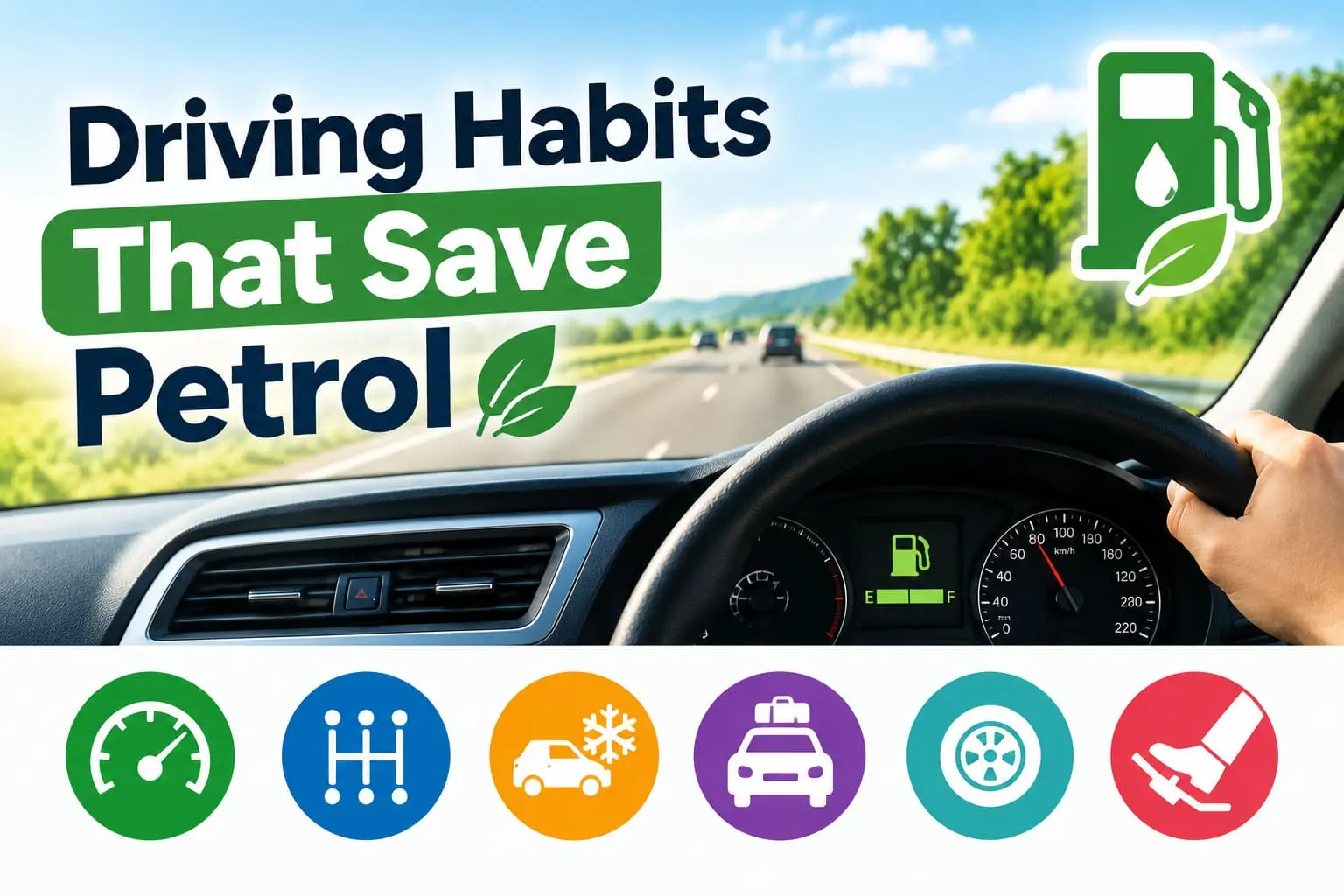
12 Fuel-Efficient Driving Habits That Save Petrol in a Car
The way you drive has a large effect on how much fuel your car uses. Two drivers in the same model can differ noticeably in kilometres per litre, and the difference comes mostly from habit. The following twelve habits cost nothing, and together they can make a meaningful difference to your monthly bill.
1. Accelerate smoothly
Pressing hard on the accelerator makes the engine burn more fuel than a gradual increase in speed. Pick up speed steadily and avoid sudden bursts, particularly from a standstill.
2. Look ahead and anticipate
Watching traffic well ahead lets you ease off the accelerator early and coast to a stop, instead of braking hard at the last moment. Every time you brake hard, you throw away the energy that fuel put into the car.
3. Keep a steady speed
Constant speed uses less fuel than constantly speeding up and slowing down. On open roads, a steady speed in the moderate range is usually most economical. Very high speeds burn much more fuel because air resistance grows quickly with speed.
4. Use the highest sensible gear
In a manual car, shifting up in good time keeps the engine turning slowly while you cruise. Do not let the engine labour in too high a gear, since that is also wasteful and hard on it. In an automatic car, a light and steady foot lets the transmission choose an efficient gear.
5. Avoid long idling
An idling engine gets zero kilometres from each litre. If you expect to wait for more than a minute, such as at a railway crossing or while waiting for a passenger, switch the engine off. Do not rely on long warm-ups. Modern engines warm up fastest by being driven gently.
6. Plan your trips
A cold engine uses more fuel than a warm one, so several short trips cost more than one combined trip covering the same ground. Group your errands, avoid the busiest roads and times, and use a map application to avoid heavy traffic and unnecessary detours.
7. Carry less weight
Every extra kilogram takes energy to move. Remove heavy items that you do not need from the boot and back seat. Take off roof racks and carriers when they are not in use, since they also increase wind resistance.
8. Keep the tyres properly inflated
Low pressure raises rolling resistance. This is one of the cheapest and most effective checks, and we cover it fully in our guide to tyre pressure and fuel economy.
9. Use the air conditioner wisely
Air conditioning puts a load on the engine. At low speeds in town, opening the windows may use less fuel, while at higher speeds an open window adds drag, so using the air conditioner can be the better choice. We explain this in how air conditioning, speed and load affect fuel use.
10. Service the car on schedule
A car that is in poor condition wastes fuel. Fresh oil, a clean air filter and good spark plugs all help. See our maintenance habits that improve mileage.
11. Do not top up beyond the click
When the pump nozzle clicks off, the tank is full. Forcing in more can push fuel into the vapour recovery system and does not give you more usable fuel.
12. Measure and learn
You cannot improve what you do not measure. Fill the tank, note the odometer, drive as usual and fill again. Divide the kilometres by the litres to get kilometres per litre. Do this for several fills and you will see how your habits change the number. Our fuel log guide gives a simple format.
What the savings are worth
Consider a car that covers 1,000 km a month at 12 km per litre. It uses about 83.3 litres. If better habits lift this to 13.2 km per litre, which is an improvement of ten per cent, the same distance needs about 75.8 litres. At an illustrative price of Rs 400 per litre, that is about Rs 33,300 compared with Rs 30,300, a saving of about Rs 3,000 a month. Over a year, it adds up to roughly Rs 36,000.
Common questions about efficient driving
Is it better to use the clutch or to coast in neutral? Coasting in neutral does not save fuel in modern cars, because the engine already cuts fuel when you lift off in gear. It also reduces your control. Stay in gear and let the engine slow the car.
Does driving slowly always save fuel? Not always. Driving very slowly in a low gear can be wasteful. Most engines are efficient at moderate speeds in a high gear, so aim for steady progress in the right gear.
How long before I see a difference? Track your mileage in a fuel log for a month before and a month after you change your habits. Many drivers find an improvement within the first few tanks.
Make the habits stick
Pick one or two habits each week instead of trying all twelve at once. For example, start by anticipating traffic and avoiding hard braking, and add steady speed the following week. Keep your log beside you, and treat the figure as a small game. Better efficiency also means gentler driving, less wear on the brakes and tyres and a calmer commute. It is a saving that you get both at the pump and at the workshop.
Use our fuel calculator to try your own distance, mileage and the current price. Remember that safety comes first. Do not tailgate, coast with the engine off or make any change that compromises control of the vehicle. Efficient driving is smooth driving, and smooth driving is also safer. For a broader view of what shapes the price you pay, read our guide to fuel prices in Pakistan.
Related articles
18 Oct 2026
Why Petrol Prices in Pakistan Fall More Slowly Than Oil Prices
Crude oil can drop quickly while the pump price barely moves. Here are the real reasons: timing, stock, exchange rates, taxes and fixed costs.
18 Oct 2026
What Is the Petroleum Levy and How Does It Affect Your Fuel Price?
The petroleum levy is one of the biggest parts of a litre of petrol. Learn what it is, why governments use it and how a change shows up at the pump.
18 Oct 2026
How the Exchange Rate Affects Fuel Prices in Pakistan
Oil is bought in dollars and sold in rupees. See, with simple worked examples, why a weaker rupee can raise your petrol price even when oil gets cheaper.
18 Oct 2026
Tyre Pressure and Fuel Economy: A Simple Check That Saves Money
Under-inflated tyres quietly waste fuel and wear out faster. Learn how to check pressure correctly and what it can save over a year.